
$3,695.00 Original price was: $3,695.00.$1,990.00Current price is: $1,990.00.
$1,695.00 Original price was: $1,695.00.$995.00Current price is: $995.00.
$1,695.00 Original price was: $1,695.00.$995.00Current price is: $995.00.
$1,845.00 Original price was: $1,845.00.$1,095.00Current price is: $1,095.00.
We will ship our Trophy Batteries internationally.
We will prepare a free, no obligation, custom shipping quote for you.
Our shipping quotes are normally DDP, Delivery, Duty Paid.
Other terms are available upon request
With DDP terms, all shipping costs, insurance, export fees, import fees, customs fees, customs duties, and taxes are included in the shipping rate quote.
Thus, you know the full cost of shipping our batteries to your destination in advance. There will be no surprise billing.
International payments are usually made via bank wire transfer. We will send you our wire transfer instructions along with your custom shipping quote.
Trophy Batteries use Lithium Ferrous Phosphate (LiFePO4) cells. These LiFePO4 cells are safer than regular Lithium-Ion cells, as they never suffer from thermal runaway.
LiFePO4 cells have been thoroughly tested, and even when abused, will not catch fire.
The LiFePO4 battery cells will not start a fire due to an internal battery cell catching fire.
Lithium Ferrous Phosphate batteries use a limited number of battery cells. This is opposed to a Lithium-Ion battery of similar capacity, which employs hundreds of Lithium-Ion cells.
The individual battery cells are the heart of any battery. Invest in new, name-brand, quality cells, like EVE Energy.
Trophy Batteries are in the 48 Volt Class of batteries, and supply, 51.2 Volts (nominal). Every 51.2 Volt Trophy Battery works with all 48V Class of Inverters.
The battery chemistry is Lithium Ferrous Phosphate which is very safe. There are 16 or 32 cells in each Trophy Battery. Some 48V batteries only have 15 cells; these batteries are less desirable.
For a top-quality battery, one must use top-quality battery cells.
Trophy Batteries uses only brand name battery cells, EVE Energy Cells.
Many battery companies use lower-quality cells or do not specify which cells they use.
In fairness, they may use good cells, but with Trophy Battery, you know which brand cells are in your battery.
The cell to cell connections (bus bars) are also critical.
Trophy Batteries use bus bars (connectors) laser welded to the battery terminals.
Laser welded connections are always superior to other methods.
Some other batteries use wires/cables or bus bars that are bolted to each battery terminal. The problem with bolts is they can become loose, which then causes problems including arcing, diminished capacity, or battery failure. Laser welded battery terminals are one of the signs of a superior battery.
Some will consider bolted terminals superior since a battery cell could theoretically be replaced easier if it fails. But, we believe this to be a fallacy. If a battery cell fails during the battery’s life, this indicates that top-quality cells were not used initially, or the BMS is not correctly balancing the cells. In addition, any replaced battery cell will not precisely match the other cells. Thus the concept of replacing a single battery cell in a battery is not practical.
The battery terminals and internal cables are also important. The terminals must be rugged and designed to carry the battery current. The wires must be a suitable size to carry the rated current of the battery. Trophy Battery uses premium tinned copper, high-temperature (200C, 424F rated), silicone rubber insulated cables. These cables are proven to carry over 200 amps of current and are standard in every Trophy Battery.
A strong metal case with rigid internal bracing is essential. Our strong case with multiple internal braces (cross members) allows the Trophy Batteries to be safely placed vertically, with the front panel facing upwards.
Other batteries may not have such a robust case or lack strong internal bracing. Both are required to ensure that the cells are not damaged in various orientations.
Lithium Ferrous Phosphate (LiFePO4) batteries have proven chemistry; they are both very powerful and safe.
But, LIFePO4 batteries have one limitation. They must not be charged when the battery is at freezing temperatures.
Trophy Batteries have multiple temperature sensors strategically located in the battery. If the battery temperature gets close to freezing, then during charging, the battery heaters will come on to heat the battery to a safe temperature, then actual charging will proceed.
Our heaters will never drain your battery. They are powered by the charging current and are only used when the battery cells are close to freezing. As soon as the battery temperature has risen to a safe temperature, then the heaters are turned off, and normal charging resumes.
The heaters are located under the battery cells in direct contact with the battery cells. The heaters output 100 Watts or more of heat.
The entire heating is controlled by our BMS. It is fully automatic. When the battery is too cold, the heaters will protect your batteries from damage. Charging a frozen LiFePO4 battery cell will permanently harm it. With our heaters, you never have to worry this issue.
The batteries should be located in a relatively protected area, such as indoors, in a shed, or in a garage. They should not be located outdoors, exposed to the elements.
During discharge, the batteries will generate some heat. If you are in a very cold environment, it is ideal to insulate the batteries from excessive cold.
All Lithium Ferrous Phosphate batteries work best around room temperature. When very cold, the output power will be lower like all other batteries. Thus, insulating the batteries from extreme cold is a great idea. When the batteries return to normal temperatures, the batteries will return to their normal power output.
Many other batteries do not have internal heaters and a Battery Management System that will control the heaters.
The lack of heaters in other batteries is a problem. Please consider the following scenario.
In Texas, in February 2021, the ordinarily moderate weather turned freezing, and the electrical grid power failed in many locations. Then Grid-tied solar systems without batteries shut off to protect the utility workers. This extended period of below-freezing weather caused many parts of the electrical grid in Texas to fail. The extended extreme cold also caused the natural gas system to fail, as the gas valves and infrastructure were not designed for such cold weather.
Thus, many people with solar systems found themselves without utility power, natural gas, and solar power for days, which was a significant crisis for many families.
If the homes with solar power also had backup battery systems, they would have continued using their solar power with one caveat. If using LiFePO4 chemistry, their backup battery would have to be kept warm (above freezing) to allow the solar system to charge the battery.
Typical backup battery systems with temperature sensors but no heaters would then stop charging. Thus their backup battery systems would quickly drain without the ability of their solar system to recharge their batteries. If they had batteries without proper temperature sensors, they were at risk of destroying their batteries if the solar system attempted to charge a frozen Lithium Iron Phosphate battery.
With an inverter that works with batteries, you will have several significant new capabilities.
You may use Trophy Batteries without a solar system.
In some areas, electrical utilities charge substantially more for electricity at peak times.
Some then have lower off-peak rates, and some may have super-off-peak rates, usually in the middle of the night.
Time-of-Day, or Peak Rates, can make electricity very expensive when you need it most.
With a Trophy Battery system, along with suitable inverters, you can charge your batteries when the electricity is the cheapest, then use battery power during times when electricity is expensive
An investment in a Trophy Battery system can help you avoid the high cost of electricity for years.
Lithium Ferrous Phosphate batteries have a much longer lifespan if they are not routinely discharged to 0%.
Trophy Batteries have a premium BMS, which has been factory programmed to prevent accidental abuse of the battery, which would or could significantly diminish the life of your battery.
Just as you should never fully discharge Lead-Acid batteries below 50%, we recommend that you not fully discharge your Trophy Battery or any other Lithium Ferrous Phosphate battery.
For routine, day to day operations, we recommend not discharging the battery below 20%. However, in emergencies, when you need the power, you may discharge it to approximately 5%.
At this point the battery will automatically shut down.
1. This protects the battery, as a Lithium Ferrous Phosphate battery can be harmed if discharged to 0% and then not recharged within 12 hours.
2. This provides you with a small amount of power to restart your inverter(s) easily.
Trophy Battery provides conservative capacity ratings for all of its batteries. If another company built a battery with the same components, they might rate it higher. Providing conservative capacity ratings is a little complex, so we offer the following information.
Top-tier battery cell manufacturers, such as EVE Energy, provide very conservative battery ratings. For example, a brand new EVE Energy cell rated at 105 AH (Ampere Hours or Amp Hours) will initially provide around 110 AH.
All brand new, adequately stored batteries will initially provide more capacity than after being used for a while. This is normal and expected. For top-tier batteries, this capacity drop-off will be minimal.
Then over time, the capacity will slowly diminish, provided one uses proper battery management techniques. We cover these techniques in another section, but briefly, they are:
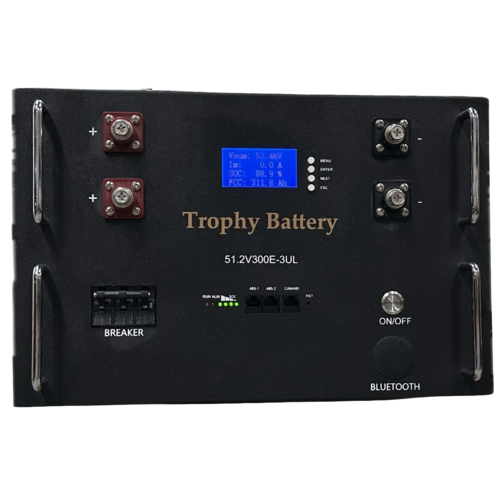
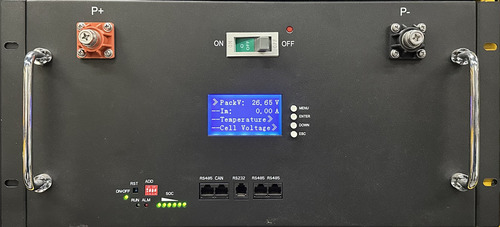
Only top-quality materials are in Trophy Batteries. The cells are name brand. The Battery Management Systems (BMS’s) are top-quality devices. They all have an LCD panel that shows the overall status of the battery and detailed information on each battery cell. The 51.2V300E-3UL using 16s3p configuration thus displays information on each triplet of 102 AH Cells in parallel.
Most importantly, every individual battery cell is individually tested before constructing the battery. Then the cells are balanced together. This lengthy and thorough testing ensures that a Trophy Battery will have a long life. This expensive testing and balancing of the cells contribute to the high quality of Trophy Batteries.
The premium Trophy Battery BMS keeps the cells in balance. No separate manual balancing of the cells is necessary. The LCD control panel will display the cell voltages so you can see that the cells are balanced. Typically, the cells will be within a few millivolts during the life of the battery.
Every Trophy Battery uses Laser Welded battery cell connections. This is the highest quality and most reliable way to connect the 16 or 48 battery cells. Alternative methods, including busbars bolted to battery cells, are not as reliable.
The battery case is heavy steel, and there are strong cross members to ensure the strength and rigidity of the battery case
“Battery Cycle Life” is a term used to denote the number of times a battery may be charged and discharged, with the battery capacity remaining at 80% or higher. Note, after this number of cycles, the battery is still very useable.
But, please be very cautious when comparing Battery Cycle Life values you see in marketing materials.
Lithium Ferrous Phosphate batteries can have a long life and an exceptionally long life under the right conditions. Here is an example. Over the life of a battery, if it was charged to 100%, deeply discharged, with high ambient temperatures, then the number of Battery Cycles will be low.
If a battery is charged to around 95%, then discharged to only 50% on most charge-discharge cycles, and kept at reasonable temperatures, the battery will last an extraordinary number of cycles.
Thus, to make an informed decision a claim of very high Battery Cycles, one needs to know the starting state of charge, the rate of charge, the depth of discharge, the rate of discharge, the ambient temperature of the tests, and the storage conditions of the battery before performing the tests.
Marketing Materials rarely provide all of these details.
A manufacturer’s battery specification may list only 2,500 to 3,500 under demanding conditions, then show charts showing alternative conditions where the “Battery Cycles” can reach 10,000 or more.
Note: A claim of 7,000 battery cycles may be perfectly valid, provided one uses standard practices to help ensure the long life of the battery. Under more demanding conditions, the number of cycles may be much lower.
So, the same battery, rated under differing conditions, may be rated at 3,000 to 10,000 cycles or more. Thus, please be cautious when you read claims of high battery cycles.
It is important to note that when using batteries in solar systems, the nature of the charge/discharge cycle typically results in a long life for the battery.
The same applies when using batteries in Uninterruptable Power System for one’s home or another facility. This battery application, proving power on-demand, also typically results in extended battery life.
Batteries stored at high temperatures, charged to 100%, then discharged to a low level every day will not last as long as the same battery used under more favorable conditions.
To ensure that your battery lasts a long time:
Keep the battery relatively cool. Temperatures in the 90s (F) are acceptable, room temperature is even better, but much over 105F diminishes the battery’s life.
Purchase enough battery capacity, measured in Amp-Hours (AH) or Watt-Hours, so that you are not deeply discharging your battery daily. You may purchase multiple batteries and connect them in parallel or purchase larger capacity batteries.
Ideally, charge your battery to only 98% or so and discharge your battery (generally) to only around 30%, or even better, 40% or higher. Under these conditions, each charge-discharge cycle does not even count as a Battery Cycle.
Note: Most car manufacturers never discharge their batteries below a certain level in their battery-powered and hybrid vehicles. They are using the practice of lightly discharging the battery to extend the life of the batteries. This enables their batteries to be used every day for many years.
For emergencies, when the electrical grid is down, or you expect it to fail for some reason, it is perfectly acceptable to charge your battery to 100% and then discharge it to 20% or even 5% during the outage. This technique will count as one “Battery Cycle” out of the many thousands of cycles available in the battery.
Batteries fall into general classes, such as 12 Volts, 24 Volts, or 48 Volts.
Most cars use a 12 Volt class battery, but the voltage varies, as it does in all batteries. When fully charged, its voltage is higher than 12 volts, and the voltage lowers during discharge. The nominal voltage for a lead-acid car battery cell is usually 2.2 volts and contains six cells, so the nominal voltage for a 12-volt car battery is 13.2 volts. But, it is in the 12-volt battery class.
Lithium Ferrous Phosphate batteries use cells that have a nominal voltage of 3.2 volts.
Using 15 of these cells creates a battery with a nominal voltage of 48 Volts. Some battery manufacturers build batteries with only 15 cells.
Batteries with 16 cells are better than batteries with only 15 cells. A 16 cell battery packs more power than a 15 cell battery.
Trophy Batteries always contain sixteen (16) 3.2 Volt nominal cells and thus are rated at 51.2 Volts. But our 51.2 Volt batteries are still classed as 48 Volt batteries. Therefore 48 Volt rated inverters are a perfect match.
Volts are a measure of ¨Electrical Pressure¨. The higher the voltage, the higher the ¨Electrical Pressure¨. An analogy is a water hose. Volts are like the water pressure in a hose.
Amps (Amperes) are a measure of the flow of electricity, which is called electrical current.
The higher the current, the higher the amps. The electrical current is like the flow of water in a hose.
Amp-Hours (AH) is a measure of power in a battery. A 100 Amp-Hour battery is more powerful than a 50 Amp-Hour Battery.
This section is a simplistic discussion of Amp-Hours as battery chemistry, and other factors affect the power output. Still, generally, a 100 Amp-Hour (AH) battery can output 100 amps for 1 hour, or 50 amps over 2 hours, or 20 amps over 5 hours.
Please note the other factors mean that this simple math does not always hold up in actual practice but gives a general guideline of how this works.
Watts are a measure of “Electrical Power” or Energy. Watts are calculated by multiplying Volts times Amps. Watts are a familiar concept to many, as one may be familiar with an old fashion 100 Watt light bulb, which uses (approximately) 100 watts of electrical current. You may also be familiar with a portable room heater rated at 1,500 watts.
Watts are also helpful as many appliances are rated in Watts. Thus, the number of watts that your appliances and other devices use may be used to size a battery system.
A battery with 48 Volts nominal (15 cells) that can output 100 amps is a 4,800 Watt -Hourbattery.
A battery with 51.2 Volts nominal that can output 100 amps is a 5,120 Watt-Hour battery.
The 51.2-volt battery is more powerful, thus more desirable.
Watt-Hours are a measure of a battery’s power or energy. Like Amp-Hours, Watt-Hours measure how many watts of energy a battery can output over time.
A 5,120 Watt-Hour battery can output 5,120 Watts for 1 hour or 512 watts over 10 hours. As before, other factors affect the battery’s energy, so these values are general guidelines.20
Charging any Lithium Ferrous Phosphate battery requires a proper Lithium Ferrous Phosphate charger or one or more inverters that support Lithium Ferrous Phosphate batteries.
Use only DC (Direct Current) of the proper voltage and current for charging these batteries. You must use a proper LiFePO4 charger or inverter rated for 48 Volt batteries.
Never use any voltage of AC (Alternating Current, standard household current) to directly charge our batteries. You must use an appropriate charger or inverter to charge the batteries.
Never use a vehicle’s alternator to directly charge our batteries. The alternator will probably be the wrong voltage and will not follow proper charging techniques.
Using a proper DC to DC Charger, such as a Victron 12V to 48V DC to DC Charger, you can safely charge our batteries without harming the alternator in your vehicle.
Quick Answers
Sol Ark 5K and 12K Inverters
Battery Type: Lithium (LiFePO4)
Absorption Stage: 56.8
Float Stage: 54.0 to 55.2
Equalize Stage: 56.8 Volts and set the duration of Equalization Stage to 0
Growatt SPF 3000TL LVM-48P
Battery Type, Menu Item 05, US2
Constant Voltage Charging Voltage, Menu Item 19: 56.8, their default is 56.4
Floating Charging Voltage, Menu Item 20: 54.0 or 55.2, their default is 54.0
Low DC Voltage Cutoff, Menu Item 21: 48, their default is 42.0
Growatt SPF5000ES
Battery Type, Menu Item 05, US2
Constant Voltage Charging Voltage, Menu Item 19: 56.8, their default is 56.4
Floating Charging Voltage, Menu Item 20: 54.0 or 55.2, their default is 54.0
Low DC Voltage Cutoff, by voltage Menu Item 21: 48.0 or 47.9
It is perfectly ok to discharge a Trophy Battery down to 5%, but doing so routinely will reduce the life of your battery.
Routinely discharging to 30% or higher, as opposed to 20%, will extend the life of your battery.
For emergencies, where you need all of the power of the battery, the battery cutoff voltage may be reduced to 43.3V
After the emergency, restore to 48V
Detailed Discussion
Hybrid Inverters, Solar Charge Controller, and Battery Chargers typically have charging profiles.
These typically can be customized for different types of batteries and battery chemistries.
A charge profile for a Lead-Acid battery will be different than a Lithium Ferrous Phosphate battery like all Trophy Batteries.
Battery Charging Profiles have different names for the same concepts.
Constant Current / Bulk Charging
This is where the charger outputs a specific amount of current to the battery. The charger may be more sophisticated and ramp up to the specified constant current during this initial phase of battery charging.
For Trophy Batteries, the most desirable charging current is up to 0.5 (or ½) C. C is the AH (Amp-Hour) rating of the battery:
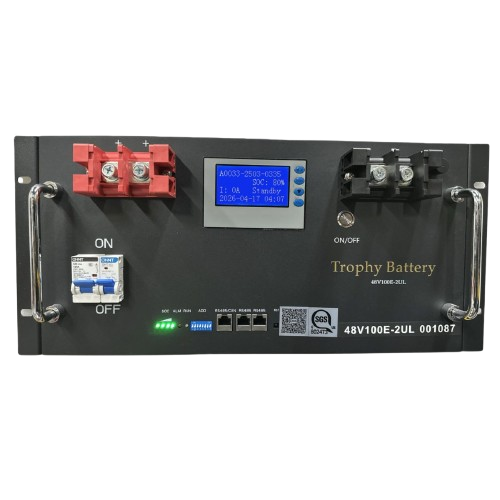
48V100E-1, 48V100E-2UL, 51.2V100E-3UL: 100 AH (Amp-Hours), C=100 Amps, Battery Cell=105 AH, 0.5C = 52.5 amps
48V110C-1, 110 AH (Amp-Hours), C=110 Amps, Battery Cell=120 AH, 0.5C = 60 amps
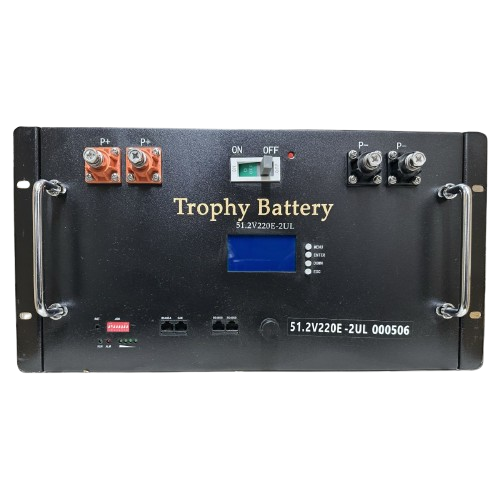
48V220E-1 and 51.2V220E-2UL 220 AH (Amp-Hours), C=220 Amps, Battery Cells=240 AH, 0.5C = 120 amps
48V304E-1, 48V304E-2, and 51.2V300E-3UL 150 amps
Note, it is perfectly acceptable to use a lower charging rate; you do not have to charge at 0.5C.
It is also perfectly acceptable to use a higher charging rate, above 0.5C, but you should never exceed the full C value. It is desirable, on a routine basis, to stay below the full C value. For an extended battery life, up to 0.5C charging is desirable.
The maximum charging amps is also limited by the circuit breaker in each battery:
48V110C-1, 48V100E-1, 48V100E-2UL, and 51.2V100E-3UL have a 100 Amp circuit breaker
48V220C-1, 48V220E-2UL, 51.2V220E-2UL, 48V304E-1, 48V304E-2, and 51.2V300E-3Ul have a 200 Amp circuit breaker
If you have multiple batteries in parallel, the desired charging rates can be multiplied by the number of batteries.
Note, with large and very large battery banks, you may not be able to achieve the desired 0.5C times the number of batteries, charging rate. This is perfectly acceptable. On days where you can charge your batteries more due to more solar power, then you will build up the charge in your batteries over time.
Summary:
The most desirable charging current, for the maximum life of your batteries, is to routinely charge at any number of amps up to the following.
48V100E-1, 48V100E-2UL, 48V100E-3UL: Recommended up to 52.5 amps, maximum charging rate 100 amps
48V110C-1: Recommended up to 60 amps, maximum charging rate 100 amps
48V220C-1, 48V220E-2, 51.2V220E-2UL, 48V304E-1, 48V304E-2, 51.2V300E-3UL:
Recommended up to 120 amps, maximum charging rate 200 amps
Constant Voltage/Charging Voltage/Absorption
After the Bulk or Constant Current stage of charging, sophisticated chargers or inverters convert to a Constant Voltage method of finishing the charging of the battery.
We recommend a setting of 56.8 Volts for this phase of charging.
Some will use the term Absorption for the Constant Voltage charging stage, for example, Sol Ark, others will have a separate battery charging phase of Absorption.
Since Lithium Ferrous Phosphate batteries do not need an absorption phase, just set Absorption to the same value that you set for the Constant Current stage, 56.8 Volts.
Equalization
Lead-Acid batteries in use for energy storage may need an equalization stage. Trophy Batteries never need equalization.
If you can disable the equalization stage, or set the duration to zero, please do so.
If you cannot, then set the equalization state to the same value, 56.8 Volts.
Please feel free to call us for assistance at 803-380-6211.
At Trophy Battery, we believe in providing conservative ratings for our products because we aim to under-promise and over-deliver.
Our batteries utilize EVE Energy prismatic cells, with some models using 102 or 105 Amp-Hour cells and others using 230 or 304 Amp-Hour cells. All EVE cells are exceptionally well-rated. For example:
– Our 220 Amp-Hour batteries use cells rated by EVE as 230 Amp-Hour, which initially provide approximately 239 Amp-Hours.
– Several of our 100 Amp-Hour batteries use cells rated by EVE as 105 Amp-Hour, initially providing over 110 Amp-Hours.
Please note that it is perfectly normal for a battery’s Amp-Hour and Watt-Hour capacity to diminish over time as the cells age.
This process is known as “Calendar Aging.”
By following our battery guidelines, you can help maintain your battery’s capacity and ensure its longevity.
Ideally, when expanding one’s battery bank, one would use the exact same brand and model of battery.
We have proven that greater flexibility is possible and practical.
Users have added batteries with different capacities to an existing battery bank. And different models have also worked.
We prefer to advise each customer individually.
We will consider the number and type of batteries that you already have and then make recommendations.
Thus, please call us at 803-380-6211 so we can help.
Lithium Ferrous Phosphate (LiFePO4) is the chemistry in the Trophy Battery’s cells.
Unlike most lead acid batteries, these batteries can be deeply discharged.
But, routinely discharging the batteries below 20% State-of-Charge reduces their life.
Batteries can be deeply discharged to 5% State-of-Charge when necessary, such as in a power outage.
As long as this is not done routinely, this does not diminish the life of the battery.
————————–
One can significantly extend the life of Lithium Ferrous Phosphate batteries by following these guidelines.
A. Keep the battery near room temperature. Around 77F or 25C is an ideal temperature.
It is acceptable to allow the battery to reach around 100F or 37.8C or slightly higher. But, it is advisable to keep them cooler.
The battery must be kept above 0F or -17.78C at all times
If you are comfortable, then the battery will be “comfortable” and have a longer life.
Higher temperatures, such as over 105F or 40.5C will reduce the life of the battery.
Colder temperatures reduce the power output of a battery. As the temperature gets colder, the power output gets lower, and the ability to charge the battery diminishes greatly.
Lithium Ferrous Phosphate is great battery chemistry for many reasons, including safety.
But, one cannot charge this type of battery if any cell is at or below 32F or 0C, which will damage the battery.
All Trophy Batteries have built-in heaters.
This heater diverts the charging current to the battery heaters until the battery is warm enough to be charged without damage.
Please note that our internal heaters never use battery power to keep the battery warm.
If the battery has charging power, it will be used to warm the battery enough to enable so that it can be charged.
This is an automatic process.
We will personally advise our friends on the best ways to keep their batteries at ideal temperatures, 803-380-6211.
B. Limit the depth of discharge. Every Lithium Ferrous Phosphate battery can be discharged to 20% routinely.
However, regularly limiting the depth of discharge will significantly extend the battery’s life.
If you oversize the battery system so that it is only discharged to about 40% or greater routinely, the battery life will be extended.
The less you discharge the battery, the longer the life of the battery. Note that “Calendar Aging” also occurs, regardless of how the battery is used.
C. Use Moderate Charging and Discharging Currents
Batteries work best when charged and discharged at the appropriate amperage for the battery size.
Good charging and discharging rates for a 100 Amp-Hour battery are 50 amps.
The batteries are capable of higher rates for both, but these moderate rates extend the battery’s life.
For a 110 Amp-Hour battery, the best rates are around 55 Amps.
For a 220 Amp-Hour battery, the best rates are around 110 Amps.
For a 304 or 300 Amp-Hour battery, the best rates are around 125 to 150 amps.
For multiple batteries in a battery bank, the above values can be mulltiplied by the number of batteries.
For large battery banks you may not be able to reach the recommended rates above, but this is perfectly acceptable.
These are approximate recommendations; it is not necessary to always charge or discharge at precisely these rates.
When considering buying a battery system, it is best to consider your power needs.
The following information is very general in nature:
Your actual needs may be much more or much less.
Your actual usage will vary, your battery run time will vary.
Our calculations may not apply to your specific situation.
We recommend considering the devices you want to power, their wattage, and how long they need to run during a power outage.
Your “Critical Loads” are the devices that you consider essential.
These typically include refrigerators and freezers, television, and some lighting.
Depending on your climate, you may need to power a furnace.
If you have a modern refrigerator and freezer, these do not use much electrical power. They may only use 100 watts. And it is unlikely that they run 24/hours a day.
Thus, 200 watts, running for an average of 8 hours a day, is only 1,600 Watt-Hours a day.
Then powering a modern television may only use 70 watts or so, and you may have it on for 12 hours a day, thus 840 Watt-Hours a day.
If you use LED lighting (and you should), each light on average is only 10 watts. If you have on ten lights, for 8 hours a day, this is only 80 watts-Hours.
A gas-powered forced air furnace motor may use 600 watts (more when starting), and run only 10 hours a day, thus 6,000 watts-hours.
The above are just the basics for keeping your food safe and connected to the rest of the world via television.
______________________________________________________________________________________________________________________________________________________
With the above level of very Spartan living, without including the furnace, you might need 1,680 watts-hours per day.
A 5,120 Watt-Hour (conservatively rated) battery, if you discharge it to 20%, gives you about 4,096 watts-hours.
With every Trophy Battery, we lower our Watt-Hour rating. The actual capacity of the battery is greater, but we do not count the last 5%.
Many inverters are 85% or higher in efficiency. The 4,096 x 85% = 3,481.6 Watt-Hours.
So, with only one 100 AH (Amp-Hour, 5,120 Watt-Hour battery, you can run the above critical loads (only) for about two days.
But, adding in a gas-fired forced-air furnace might add 6,000 Watt-Hours for a total of 7,680 Watt-Hours a day. In this case, the same battery may power your critical loads for around 10.8 hours.
If you add more batteries and run them in parallel, the Watt-Hours provided by your Battery System will increase.
Using this exact scenario, counting for not discharging below 20% and 85% inverter efficiency, with two batteries, your run times double, with three, your run times triple.
______________________________________________________________________________________________________________________________________________________
Many people may wish to purchase multiple batteries, especially in areas with frequent power outages, time-of-day electrical rates, areas prone to natural disasters, or those preparing for major electrical grid failures.
Also, many people will want to use more power. Electrical Water Heaters and Stoves/Ovens use a lot of energy, as do Air Conditioning systems.
A Trophy Battery system with multiple batteries can be very powerful.
For example, our 220 AH (Amp-Hour) battery provides 11,264 Watt-Hours. Adjusting for discharging to 20% is 9,011 Watt-Hours. Adjusted for 85% inverter efficiency is 7,659 Watt-Hours. Multiplying by 16, since one Trophy Battery system can consist of up to 16 batteries is 122,552 Watt-Hours or 122.5 KiloWatt-Hours.
You may review your electrical bill to determine how many KiloWatt-Hours you use a month, then calculate your daily usage, or your statement may show the average daily usage.
Another advantage of a multiple battery system is that the available current for your inverter(s) increases.
For a single 48V100E-2UL or 51.2V100E-3UL battery, the charge and discharge current should be kept around 50 amps, but it can go higher up to 100 amps.
For a single 48V220E-1, 51.2V220E-2UL, 48V304E-1, 48V304E-2, and 51.2V300E-3UL batteries,
the charge and discharge current should be kept around 110 amps, but it can go higher up to 160 or higher amps.
By adding additional batteries, these current values are increased (multiplied by the number of batteries).
Note, if you are going to charge your batteries from a Solar Power system, size your system to keep your batteries charged.
A small Solar Power System will not be suitable for a very large battery system.
If you use your batteries for time-of-day rate avoidance, your electrical system may be powerful enough to keep your batteries charged.
Note that you will want to charge your battery when the lowest possible electrical rates are in effect.
The same applies if using a Trophy Battery system as an Uninterruptable Power System for your home.
You typically use the electrical grid to charge your batteries.
But, if you are off-grid, you may use a generator or Solar Power to charge your batteries.
In this case, your Trophy Battery system operates like a noiseless, fumeless generator without carbon monoxide hazards.
Please note that this section is general in nature and cannot be relied upon to apply in your case.
Please note that a Trophy Battery system costs just a fraction of many other battery systems.
Examples include Tesla Powerwalls, Sonon, Enphase, and Generac.
Trophy Battery uses only top-quality, new, name-brand battery cells.
We use sixteen (16) 105 Amp-Hour rated EVE Energy cells in our very popular 100 Amp-Hour rated, 5,120 Watt-Hour Battery.
We use sixteen (16) 102 Amp-Hour rated EVE Energy cells in our popular 51.2V100E-3UL. Note, the 102 Amp-Hour EVE cells in a newer design. It is very conservately rated.
We use sixteen (16) 230 Amp-Hour rated EVE Energy cells in our 51.2V220E-2UL battery. We conservately rate this battery at 220 Amp-Hour and 11,264 Watt-Hour.
We use 48 102 Amp-Hour rated EVE Energy cells in our large-capacity 300 Amp-Hour rated, 15,360 Watt-Hour battery. These cells are in a 16s3p configuration.
All Trophy Batteries pass the UN38.3 testing, which ensures that the batteries are safe for shipping.
UN38.3 is the third section 38.3 of the United Nations Dangerous Goods Transport Experiment and Standards Manual (for safe transportation of batteries). The purpose is to ensure the safety of our batteries during transportation.
Our battery cells pass these rigorous tests.
T.1 Altitude simulation
T.2 Thermal test
T.3 Vibration
T.4 Shock
T.5 External short circuit
T.6 Impact/Crush
T.7 Overcharge
T.8 Forced discharge
The detailed, official US38.3 test certifications are available upon request.
Trophy Battery products must not be used in any life-support or life-critical applications.
You may use a Trophy Battery to power some medical devices if the device is not life-support or life critical.
Trophy Batteries must not be used for any critical application, such as in the nuclear power industries, or in any application where the loss of power would cause a critical situation.
All batteries have inherent limitations.
Battery power is inherently limited and can only provide power for a limited time.
Batteries can fail.
Trophy Battery LLC voids all warranties if its products are used in any life-support, or life-critical application, or used in the nuclear power industries.
Trophy Battery LLC disclaims all liability if any of its products are used in any critical application.
==================
Due to the large amount of power in our batteries, you should use a licensed electrician to connect your batteries to your inverter(s) and the inverters to your AC loads.
You must use protective gear, insulated gloves, proper eye protection, and insulated tools.
If you choose to install the batteries yourself, please have a licensed electrician check your work. During installation, ensure that the Circuit Breaker is in the off position at all times. Also, you should measure the terminals with a voltmeter to ensure that no current is flowing before you perform the installation or any work around the battery or batteries.
Every one of our batteries is heavy, weighing from 100 to over 300 pounds, even more when in their shipping cases. We recommend getting assistance when handling the batteries.
You must use the proper type and size of electrical power cables to avoid fires.
Trophy Battery cannot be held liable for improper installation or handling of the battery, including all injuries or deaths.
Trophy Battery cannot be held liable for your installation and any problems that were not caused directly by the battery itself and not the installation or advice we have provided.
All Trophy Batteries use M8 size bolts on the battery terminals. These are superior to the typical M6 size terminals on other batteries.
We recommend using 5/16″ cable lugs, as they provide more contact area with the battery terminals.
You may use 3/8″ battery cable lugs, but the width must be less than 7/8″ on many batteries.
They are not as good as using 5/16″ cable lugs.
Important Information about the 51.2V220E-2UL Battery
To power on the Trophy Battery 51.2V220E-2UL battery the first time:
1. Turn On the Circuit Breaker.
2. Press gently and hold down the recessed Reset Button for 6 to 7 seconds.
You will see the LEDs come on after 6 seconds or 7 seconds.
When you see the LEDs come on, release the Reset Button.
After you power it up the first time, you will only need to:
1. Turn On the Circuit Breaker.
2. Gently hold down the recessed power switch for 1 to 2 seconds.
========================================================
After this initial power on, then the following apply:
Gently press and hold the Reset Button:
1 to 3 seconds to Power On (The Circuit Breaker must be on)
4 to 6 seconds to Power Off
6 to 10 seconds to perform a Hardware Reset of the BMS (The Circuit Breaker must be on)
Please feel free to call us at 803-380-6211 for assistance or support.